
Seismic Changes In Child Welfare Policy
We recently published our 2025 impact report. If you didn't see one in your mailbox, email us and we'll get one to you.
I want you to see it because it includes several triumphant stories of hope and healing, stories that you made possible. When you give, volunteer, or help spread the word, you are changing the trajectory of kids in foster care, you are supporting families who need it most. You should be proud, and the impact report is our annual attempt to give you a trophy.
I am constrained for space when I write for the impact report, so this year I thought that I would offer a more detailed report—in pixels rather than on paper—regarding the state of child welfare generally and Skookum in specific.
Since 2018 the population of foster care has fallen by more than 20 percent. Nationwide we are removing fewer children from their family and finding alternative ways to keep kids safe and support families as they strive to build a life that they love and to become the parents they aspire to.
The change was launched with the passage of the Family First Prevention Services Act (FFPSA) which made federal funds available to pay for these alternatives. In response, many states are shifting their focus and resources away from traditional removal/placement foster care and toward evidence-based prevention programs.
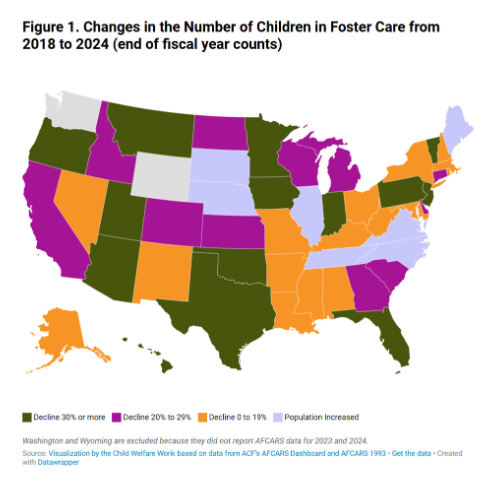
Washington is no exception.
Our state is grey in the map above for some complicated technical reasons, but we are seeing the same trend here in Washington. At its peak, the population of foster care in our state was nearly 10,000. Today it is less than half that.
This is great news! Even at its best, foster care is traumatic for children. And it is rarely at its best. The professionals who respond to reports of child abuse and neglect do heroic work, but these are challenging circumstances. Getting it "right" even a majority of the time, is difficult. Among any 3 reasonable people you are likely to find 3 different ideas of what "right" would even mean.
However, if children can be kept safe without subjecting them to the trauma of foster care, nearly everyone agrees we should. The ‘if’ in that sentence is important, and in Washington we have some truly exceptional alternatives to foster care, evidence-based programs that are known to be effective in supporting families as they walk back from the brink of personal disaster.
So, partially in response to FPSSA, Washington passed HB 1227 the Keeping Families Together Act which raised the legal standard for removing children and further prioritized placing children with relatives whenever possible. However, another thing is almost universally agreed upon: we did not get it right on the first try. While the population of foster care quickly fell as intended, the number of critical incidents also spiked at the same time. A critical incident is child welfare speak for a fatality or near fatality. It's important to note that this increase is also part of a national trend, though the change was more sudden in Washington and the commonality among these cases was overdose by accidental ingestion of highly potent synthetic opioids aka fentanyl.
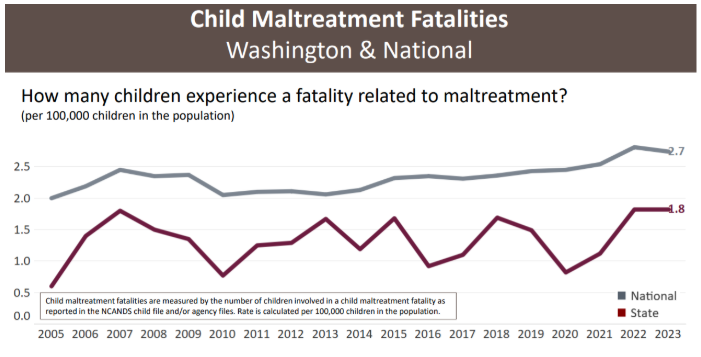
Source: Casey Family Programs presentation as part of the Child Welfare Work Session held in the House Health & Human Services Committee
In response the legislature passed SB 6109 provided further clarity for DCYF and the courts about how to weigh the risk of highly-potent synthetic opioids.
Now comes the controversy. For some, these are necessary adjustments as we walk a virtuous path. For others, the direction is wrongheaded and we ought to reverse course. As of this writing, the debate is underway with two competing proposals being considered in the legislature this session, and I am not sure what will happen next.
How does all this affect Skookum Kids?
Skookum’s earliest programs were built as a crisis response. We responded to specific and well-understood system deficiencies. In the case of The Landing, it was the 72-hour problem. In the case of Skookum Parents, it was the acute shortage of foster homes across northwest Washington. In both cases, building the program and operating it effectively addressed the need in question. After the Landing opened in 2015, there was a place in our community designed intentionally to provide exactly what children need in the critical days as they transition from an unsafe living situation to a foster home. Once Skookum Parents was up and running at full speed, it was no longer necessary to take a giant leap of faith to become a foster parent. Families could ease into the depth of commitment right for them.
There is still a need for these critical programs. We will always need foster care. I do not think it is possible to ‘solve’ child abuse. There will always be situations in which the only moral and reasonable response is to get the child out and place them somewhere safe—first the Landing and then a foster home. In other words, our community needs a stable and smooth-operating emergency shelter and foster home training and support operation. We are proud to be stewards of it.
Much like in those early days, when we leapt at these two crisis-tunities, we see the shifting landscape of child welfare policy as another chance to be even more helpful, to offer even more support to kids and families. That’s why we have invested so much effort and spent so much time telling you about Skookum Family Partnership. This new enterprise allows us to support families and prevent the need to remove children from the home they know and their parents who love them. And yet, we are still proudly asking you to volunteer at the Landing and/or become a foster parent. Our community needs all three of these things!
Today more than ever, it will take a big enthusiastic community to ensure all children can thrive at home. There are countless ways to participate, and we would love to help you find yours.